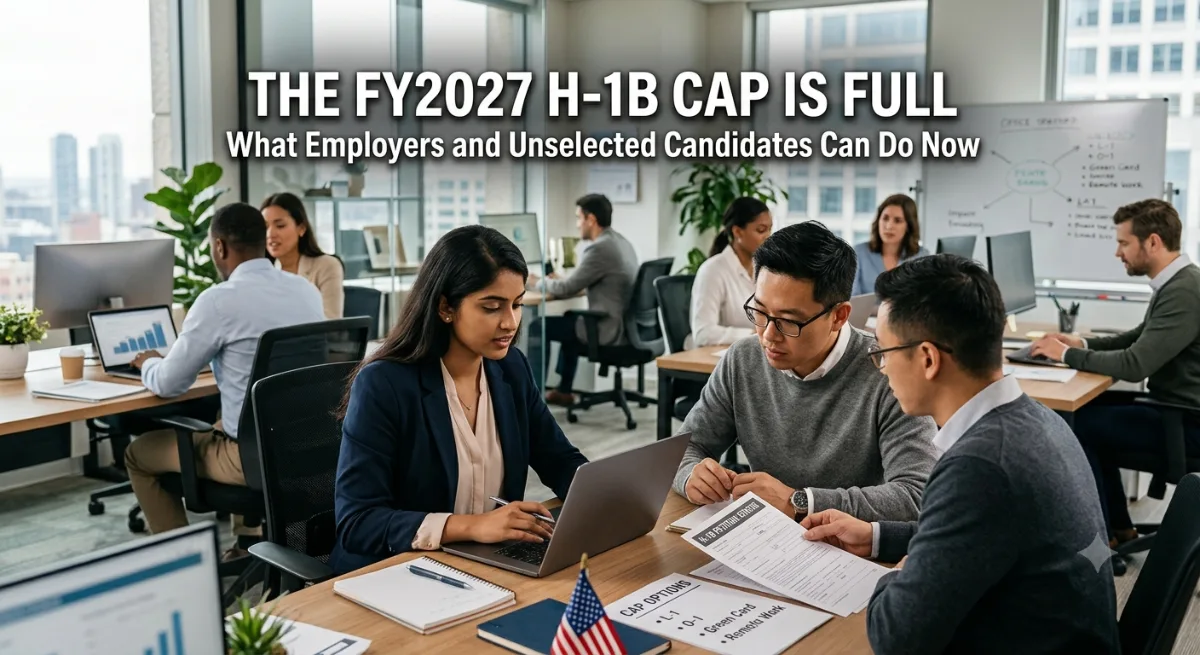
The FY2027 H-1B Cap Is Full: What Employers and Unselected Candidates Can Do Now
USCIS announced on July 17, 2026 that it has enough petitions to reach both FY2027 H-1B caps. If you weren't selected, the cap-subject route is closed until the next registration. Here is what still works, and what to do before the next season.
Published Last updated 5 min read
Not legal advice. This article is general information only. It is not legal advice, and it does not create an attorney–client relationship. Do not rely on it to decide what to do in your own case. Immigration rules change, so confirm current requirements at uscis.gov and talk to a licensed immigration attorney or DOJ-accredited representative.
In this article
On July 17, 2026, USCIS announced that it had received enough petitions to reach both the regular H-1B cap of 65,000 and the 20,000 advanced degree exemption, known as the master's cap, for fiscal year 2027. For employers and candidates who weren't selected in March, the cap-subject H-1B route for this fiscal year is closed.
That doesn't mean every H-1B route is closed, and it doesn't mean there is nothing to do now. This article covers what the cap announcement means, which H-1B petitions aren't subject to it, what changed in how registrations are selected, where the $100,000 payment stands, and how to prepare for the next cycle. Facts are current as of September 21, 2026.
How the FY2027 season ran
- Registration: opened at noon Eastern on March 4 and closed at noon Eastern on March 19, 2026. The fee was $215 per registration.
- Selection: USCIS announced on March 31 that it had selected enough registrations to reach the cap and notified employers of selected beneficiaries.
- Filing: employers with selected beneficiaries could file cap-subject petitions starting April 1. A petition may be filed no more than six months before its start date, and cap-subject petitions must have a start date of October 1 or later.
- Cap reached: July 17, 2026.
USCIS's July announcement says it has enough petitions to fill both caps, and we found no announcement of a second selection round for FY2027. If you weren't selected and no petition was filed for you, plan as though the cap-subject route is closed until the next registration.
What changed in selection: the weighted system
FY2027 was the first year USCIS used a weighted selection process. It assigns each registration an occupational wage level from I to IV, and it puts a level IV registration into the selection pool four times, level III three times, level II twice, and level I once. Each unique beneficiary is counted only once toward the caps.
USCIS says the change favors higher-skilled and higher-paid workers while keeping the opportunity open at all wage levels. In practice, a lower wage level means fewer entries and worse odds. If you weren't selected this year, ask your employer what wage level the registration was assigned and whether the job as described could reasonably fall into a higher one next time.
What isn't subject to the cap
Not every H-1B position counts against the annual limit. According to USCIS:
- Cap-exempt employers. H-1B workers who are petitioned for or employed at an institution of higher education or its affiliated or related nonprofit entities, a nonprofit research organization, or a government research organization aren't subject to the cap. USCIS's cap page describes the registration and filing window for cap-subject petitions only, not for cap-exempt ones.
- Workers who were already counted. USCIS says that if you continue cap-exempt employment, were previously counted toward the cap, or otherwise remain cap exempt, you won't become subject to the cap again during the same H-1B validity period. The details depend on your history, so have your employer's counsel check yours.
USCIS also notes that up to 6,800 numbers are set aside each year from the 65,000 for the H-1B1 program, which covers nationals of Chile and Singapore. That is a separate treaty program with its own rules, and worth asking about if you're from one of those countries.
Where the $100,000 payment stands
A presidential proclamation issued in September 2025 required certain H-1B petitions filed on or after September 21, 2025 to be accompanied by an additional $100,000 payment, or evidence of an exception from the Secretary of Homeland Security. Exceptions were described as extraordinarily rare.
That requirement is in court. On June 8, 2026, the U.S. District Court for the District of Massachusetts vacated agency guidance implementing the payment requirement for certain H-1B petitions (State of California v. Mullin). On July 24, 2026, the First Circuit denied the government's motion. USCIS says DHS strongly disagrees but will comply with the court's order while it considers next steps, and that if the order is lifted, DHS still plans to collect the payment.
The phrase "certain H-1B petitions" matters, and the situation can change again. Employers should read USCIS's proclamation page and talk to counsel before filing any new H-1B petition, rather than relying on a summary like this one.
If you weren't selected: options to raise with counsel
- Cap-exempt jobs. Petitions for universities, affiliated nonprofits and research organizations aren't part of the March registration and lottery. If your field fits, that is the most direct H-1B route this year.
- Another visa category. Depending on your nationality, your employer and your background, categories such as O-1, L-1, TN or E-3 may be options. Each has its own eligibility rules that a general article can't settle for you. USCIS's Working in the United States pages are the place to start.
- Keeping your current status valid. If you're in the U.S. on a student or work status, talk to your designated school official or your employer's immigration counsel before it expires. Don't assume a gap will be forgiven.
- The next registration. USCIS announces the dates each cycle. FY2027's ran March 4 to 19. Employers who want to register someone again should decide well before then whether the position, and its wage level, should be revisited.
For employers planning the next cycle
Three questions are worth answering early: what wage level each registration is likely to be assigned, whether each beneficiary's start date and documents will be ready for the filing window (the FY2027 petition used the 02/27/26 edition of Form I-129 and required the passport or travel document used at registration), and whether the role could instead be cap-exempt or filled through another category. Employers who wait until March to think about it lose the time they need.