What Happens at a Marriage-Based Green Card Interview
The marriage green card interview is not a trivia quiz. The officer is deciding one question: did you marry intending to build a life together? Here is how that gets assessed, what evidence counts, and what the day looks like.
Published Last updated 5 min read
Not legal advice. This article is general information only. It is not legal advice, and it does not create an attorney–client relationship. Do not rely on it to decide what to do in your own case. Immigration rules change, so confirm current requirements at uscis.gov and talk to a licensed immigration attorney or DOJ-accredited representative.
In this article
A marriage-based green card interview is not a trivia test about your spouse. The officer is answering one legal question: did the two of you marry intending to build a life together? Everything in the interview, from the documents you bring to the questions about your morning routine, is a way of testing that.
This article covers what the standard is, what evidence USCIS says counts, what happens on the day, and how credibility is judged. It draws on USCIS's Policy Manual. USCIS doesn't publish a list of interview questions, so the section on questions is general, not official. Facts are current as of September 21, 2026.
The standard the officer applies
USCIS's Policy Manual says a petitioner must show that the marriage "was entered into in good faith and not for the purpose of evading immigration laws, and that the spouses intended to build a life together at the time they were married." The central question, borrowing from a Board of Immigration Appeals decision (Matter of Laureano), is whether you intended to establish a life together when you married.
Two consequences follow. First, the marriage doesn't have to last. The Manual says the viability of the marriage, or how likely the spouses are to stay married, is not relevant. A couple who separates a year later can still have married in good faith. Second, the standard of proof is generally a preponderance of the evidence: it must be more likely than not that the marriage is real.
Who has to be there
For a marriage-based adjustment case, USCIS generally requires the I-130 petitioner to attend the interview with the applicant. All adjustment applicants are interviewed unless USCIS waives it, which it decides case by case. On the I-130 itself, USCIS says it may interview anyone, and requires an interview in defined situations, such as insufficient evidence of the marriage's bona fides, material inconsistencies in the record, large age gaps or very young spouses at the time of marriage, or a petitioner's earlier spousal petitions. See separate spouse interviews for the full list and what the policy says about interviewing spouses apart.
Since October 2025, USCIS policy also says it reviews the bona fides of each marriage twice: when the petition is adjudicated and when the adjustment application is adjudicated.
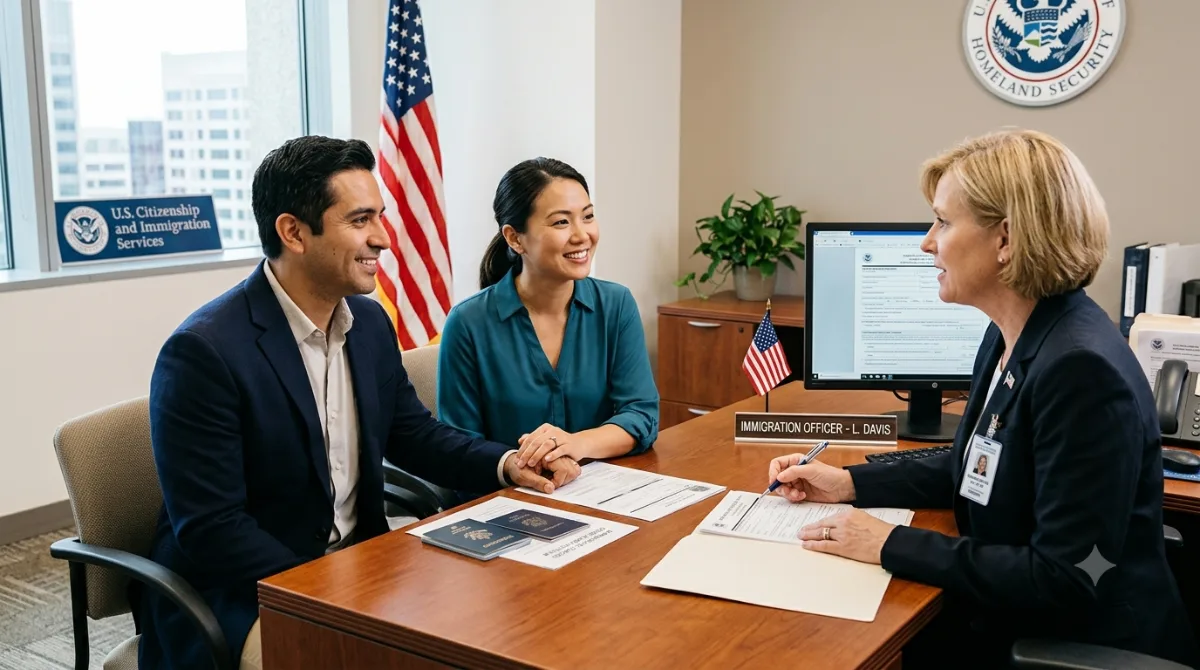
What happens on the day
- Check-in. You arrive at the field office on your interview notice with the documents it lists. Read the notice carefully for what to bring and when to arrive.
- The oath. You answer questions under oath or affirmation.
- Going through the application. The officer confirms that you understood the questions on your forms and gives you a chance to correct anything that was wrong or has changed since you filed. Now is when you fix mistakes, not after.
- Questions about the relationship. The officer may ask about your relationship, either with both of you present or with each of you separately.
- Review of evidence. The officer looks at the documents you brought, and may ask for more.
- The outcome. The officer may approve the case, ask for more evidence, or schedule another interview. Some decisions come by mail afterward instead of at the table.
If you don't speak English fluently, you can use an interpreter. USCIS says a disinterested party should generally be used, and the interpreter has to present government ID and take an oath to translate word for word. An officer may allow a friend or relative to interpret.
What evidence counts
A valid marriage certificate, registered properly with the appropriate authority, is prima facie evidence that the marriage is legally valid. Bona fides is a separate question, and USCIS lists these as examples of evidence that a marriage is real:
- documents showing joint ownership of property
- a lease showing a joint tenancy of a shared residence
- evidence of commingled financial resources
- birth certificates of children born to the couple
- affidavits from third parties with personal knowledge of the relationship
Affidavits carry more weight when they contain details. USCIS says they should include the person's full name, address, date and place of birth, and an explanation of how they know about the marriage. A letter that says "they are a lovely couple" does much less than one describing specific events the writer saw.
For marriage-based adjustment, USCIS also asks for a copy of the I-797 notice for the I-130, a copy of the marriage certificate, and proof of the legal end of any prior marriages. Bring recent evidence too, because a lease from three years ago says less than a utility bill from last month.
The questions, and how credibility is judged
USCIS doesn't publish a list, and questions vary by officer and by case. In general, officers ask about the things two people living together would know without thinking: how you met and how the relationship developed, the proposal and wedding, where you live and what it looks like, daily routines, family and friends, how you handle money, and what you plan to do next.
Credibility is a judgment about the whole record. It includes whether your answers are consistent with your documents, whether they are consistent with each other, and whether you speak from actual knowledge of the other person's life. The Manual says interviews are held when "facts presented are inconsistent or raise doubt about the bona fides of the marriage." USCIS doesn't say how many discrepancies are too many, and we wouldn't guess. Two people can honestly remember an ordinary day differently. What raises concern is a pattern that doesn't fit a shared life.
A few practical rules follow from that:
- Answer what was asked, truthfully, in your own words.
- If you don't know or don't remember, say so. Guessing is how small gaps become contradictions.
- Don't memorize a script with your spouse. It reads as rehearsed, and it isn't something you can defend if the officer goes off it.
- Correct mistakes when you notice them. The interview is set up for that.
Why honesty matters more here than anywhere
If USCIS finds that a beneficiary previously entered into or attempted a marriage to evade immigration law, it must deny later petitions for that person. The standard for that finding is "substantial and probative evidence," which is more than a preponderance but less than clear and convincing evidence, and the consequence is permanent. If you have a difficult history, a prior petition, or a marriage that took place during removal proceedings, talk to a licensed immigration attorney before your interview and consider having them attend with you.