Will USCIS Interview You and Your Spouse Separately? What the Policy Says
You will find claims online that USCIS now routinely splits spouses into separate rooms. The published policy is narrower than that. Here is what it says, what it doesn't, and how to prepare either way.
Published Last updated 5 min read
Not legal advice. This article is general information only. It is not legal advice, and it does not create an attorney–client relationship. Do not rely on it to decide what to do in your own case. Immigration rules change, so confirm current requirements at uscis.gov and talk to a licensed immigration attorney or DOJ-accredited representative.
In this article
Search for marriage green card interviews and you will find plenty of articles saying USCIS now routinely questions spouses in separate rooms. We looked for an official announcement or policy that says so, and could not find one. What the written policy does say is more limited, and it changes how you should think about preparing.
This article covers what the USCIS Policy Manual says about separate interviews, when an interview is required in the first place, and how to prepare in a way that works whether or not you are separated. Facts are current as of September 21, 2026.
What the policy actually says
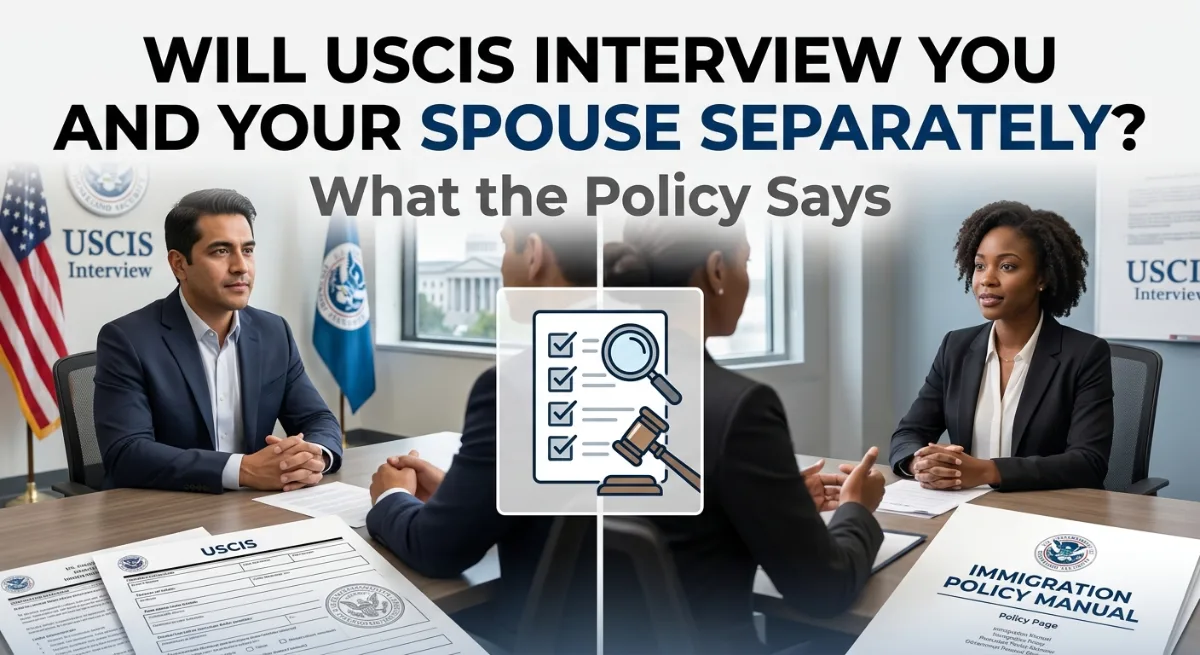
The Policy Manual's chapter on family-based petitions states that USCIS "may interview the petitioner, beneficiary, or both parties, either together or separately at any stage in the adjudication." That is a permission, not a default. The same chapter gives no procedure for how a separate interview is run, so the details differ from office to office.
There is no published USCIS data on how often couples are split. Some attorneys say they see it more often. That is their experience, not a USCIS statement, and we would treat it that way.
When an interview is required
There are two different interviews in a marriage-based case, and the rules differ.
The I-130 petition
USCIS says it may interview anyone, and it requires an interview on the Form I-130 in specific situations. Among them:
- the evidence is insufficient to decide whether the marriage is bona fide, or suggests it is not
- there are material inconsistencies or derogatory information in the record
- either spouse was under 16 at the time of the marriage, or one was 16 or 17 and the other at least ten years older
- the petitioner has filed a spousal petition for a different beneficiary before
- a prior spousal petition by either person was denied, revoked, terminated or withdrawn
- the marriage took place while the beneficiary was in removal proceedings
- the petitioner is a permanent resident who got that status through marriage less than five years before filing
The full list has eleven items, including cases where a request for evidence didn't produce reliable documents and where concerns come up after an earlier interview.
The I-485 adjustment application
For adjustment of status, the rule runs the other way. All applicants must be interviewed unless USCIS waives it, and waivers are decided case by case. For family-based cases, USCIS generally requires the I-130 petitioner to appear with the applicant.
What changed in 2025
Two policy updates matter here. In August 2025, USCIS added guidance to the Policy Manual explaining when interviews are required on family-based petitions. In October 2025, Policy Alert PA-2025-23 said USCIS will review the bona fides of each marriage twice: when the I-130 is adjudicated and again when the adjustment application is adjudicated. It also says petitioners must show the marriage is bona fide before the petition can be approved, and describes the goal as identifying marriage fraud earlier.
None of that says spouses will be separated. It does mean officers have more written reason to test the relationship closely, at more than one stage.
What a separate interview looks like
In a separate interview, each spouse is questioned without the other present, and the officer compares what each of you said about the relationship and daily life. Because the Policy Manual doesn't lay out a set procedure, treat anything more specific you hear, such as how long it takes or how the questions are ordered, as one person's experience at one office.
How to prepare, whatever the format
Prepare as if you will be separated. It costs you nothing if you aren't.
- Refresh your shared history together, don't script it. Talk through how you met, when you decided to get married, the wedding, where you live, who does which chores, whose family lives where, how you handle money, and what you plan to do next year. The goal is to jog your memories of things that are true, not to agree on answers.
- Don't memorize matching answers. Officers compare responses, and rehearsed responses tend to sound rehearsed. More important, the only answers you can defend are true ones. A finding that a marriage was entered to evade immigration law leads to a permanent bar on approving a petition for that person, and false statements carry consequences of their own.
- Expect small mismatches. Two people rarely remember a Tuesday dinner the same way. "I don't remember" is a fine answer when it's true. Guessing to fill silence is not.
- Know the legal question. USCIS asks whether you intended to build a life together when you married. It does not ask whether the marriage will last. The Policy Manual says the likelihood that a couple stays married is not relevant to whether it is bona fide. The petitioner generally has to meet the preponderance of the evidence standard, meaning it is more likely than not that the marriage is real.
- Bring evidence that supports your answers. USCIS lists joint ownership of property, a lease showing a shared residence, commingled finances, and birth certificates of children as examples, plus third-party affidavits from people who know the relationship firsthand.
- Sort out interpreting ahead of time. If you need an interpreter, USCIS says a disinterested party should generally be used, though an officer can allow a friend or relative. Arrange it as soon as your interview notice arrives.
Consider bringing a lawyer
You can attend with an attorney or an accredited representative. In a case with anything unusual in it, such as an age gap, a prior petition, or a marriage that took place during removal proceedings, that is worth doing. For the general shape of the interview, read what happens at a marriage-based green card interview.
Official sources
- USCIS Policy Manual, Volume 6, Part B, Chapter 5: Adjudication of Family-Based Petitions
- USCIS Policy Manual, Volume 6, Part B, Chapter 6: Spouses
- USCIS Policy Manual, Volume 7, Part A, Chapter 5: Interview Guidelines
- Policy Alert PA-2025-23: Family-Based Immigration: Spousal Petitions (USCIS, October 17, 2025)