Why Is My I-485 Taking So Long? What Causes Delays and What You Can Actually Do
There is rarely one reason an I-485 stalls. Some causes are ordinary, like visa availability and interview scheduling, and some are new in 2025 and 2026. Here is what is documented, and the steps that can actually help your case.
Published Last updated 5 min read
Not legal advice. This article is general information only. It is not legal advice, and it does not create an attorney–client relationship. Do not rely on it to decide what to do in your own case. Immigration rules change, so confirm current requirements at uscis.gov and talk to a licensed immigration attorney or DOJ-accredited representative.
In this article
An I-485 that takes longer than you were told has rarely stalled for one reason. Some causes are old and ordinary. Some are new in the last year, and a few are tied up in court right now. This article separates them, so that you know which ones might apply to your case and what you can do about each. Facts are current as of September 21, 2026.
Start with how USCIS counts time
USCIS defines processing time as the number of months an application took from receipt to completion, and that includes everything in between: the time to complete biometrics, the time you take to answer a request for more information, and any rescheduling of your interview. So a published processing time is an average that already includes applicants' own delays.
Where an I-485 spends its time
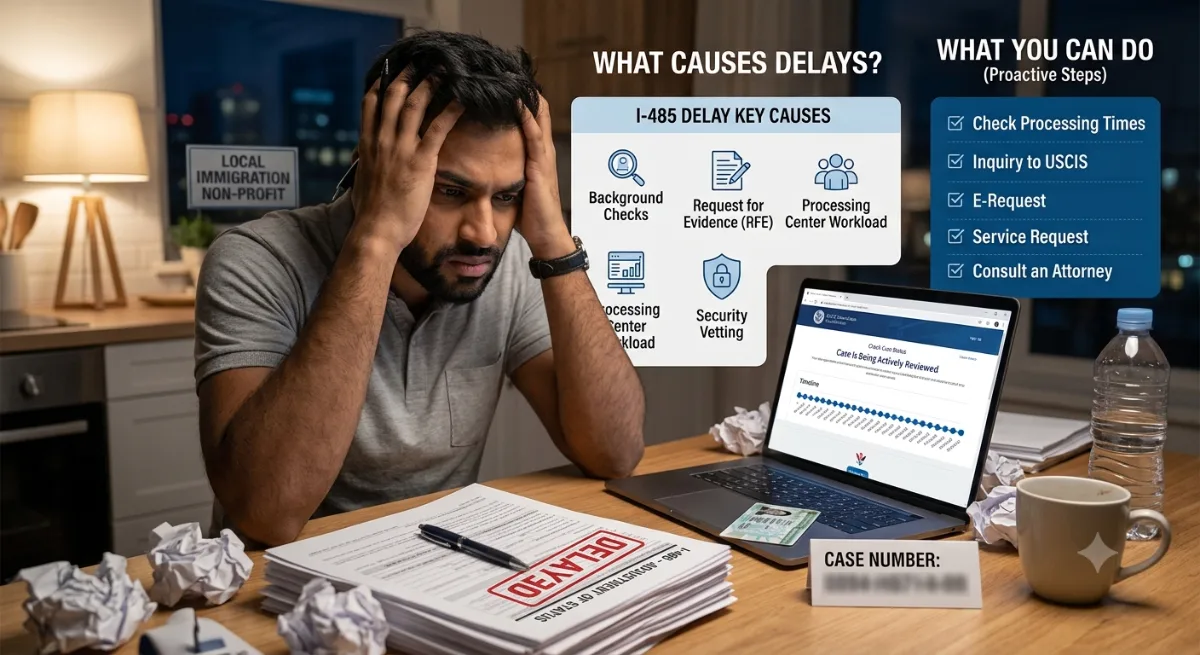
- Biometrics and background checks. USCIS mails a biometrics appointment notice after you file, and uses the results for identity verification and required background and security checks.
- Review and interview. USCIS reviews the case to decide whether an interview is needed. If it schedules one, you answer questions under oath about your application.
- Requests for evidence. If something required is missing or unclear, the clock effectively stops while you respond.
- Visa availability. In family and employment preference categories, your case can be fully ready and still wait because a visa number isn't available yet for your priority date. That's not a delay in the usual sense. See how to read the Visa Bulletin.
What is different in 2025 and 2026
Expanded screening and vetting
USCIS has described a series of additions to its screening, including new rules on reusing photographs, biometric identity checks when fingerprints are reused, shorter validity periods for certain work permits so that security checks happen more often, reviews of final arrest encounters and State Department consular database checks before final adjudication, and more social media and financial vetting. Which of these apply to a given case depends on the category and the person. USCIS also notes that a federal court vacated three of the memoranda that implemented these measures, so what is currently in force is in flux.
Holds on some applicants' cases, and the court orders about them
In December 2025 and January 2026, USCIS issued two memoranda (PM-602-0192 and PM-602-0194) telling officers to hold and review pending benefit applications filed by people from certain countries it designated as high-risk. Two federal courts have since ruled against those policies:
- June 5, 2026: the U.S. District Court for the District of Rhode Island vacated the policies in Dorcas International Institute of Rhode Island v. USCIS, with final judgment entered June 11.
- August 24, 2026: the U.S. District Court for the Northern District of California, in Red Eagle Law v. Edlow, enjoined the two memoranda and ordered USCIS to adjudicate applications "in the normal course." That order applies to a certified class of citizens or natives of the 39 countries named in two presidential proclamations, or of the Palestinian Authority, whose applications were subject to the hold.
USCIS says it "strongly disagrees" with the order but will follow its terms while the litigation continues, and that it will issue updated instructions as things develop. If your country was affected, check USCIS's court order notice and ask an attorney what it means for your case, because the situation may change again.
Closer attention to discretion
A May 21, 2026 USCIS policy memorandum (PM-602-0199) tells officers that adjustment of status is a matter of discretion and administrative grace, "extraordinary" relief compared with getting a visa abroad. It directs officers to weigh all positive and negative factors case by case, and it says that when they deny a case on discretion they must explain the factors in writing. It is aimed most at people who were admitted temporarily or paroled and didn't leave, and it acknowledges exceptions such as dual-intent categories and immigrant categories where adjustment is the only path. If you fall into the group it targets, expect a closer look, and put your evidence of positive factors in the file at the start.
A different response to incomplete filings
Since August 5, 2026, USCIS may deny a case that lacks required initial evidence without first sending a request for evidence. A complete filing avoids both the delay and the risk. See what changed and how to file complete.
What you can actually do
- Compare your case to the right benchmark. Use USCIS's processing times tool for your form and office. If your case is within the normal range, an inquiry will usually just tell you it's still pending.
- Submit a case inquiry when it's outside normal processing times. USCIS lets you ask about an application "if you think it is taking longer than expected" through its online e-request system.
- Keep your address current. USCIS requires you to update your address within 10 days of moving. A missed interview or evidence notice is one of the most avoidable causes of delay, and of denial.
- Answer every notice completely and before the deadline. A partial response to an RFE is now treated as a request for a decision on what's in the file.
- Don't travel without advance parole. USCIS says that if you leave the United States while your I-485 is pending without first getting advance parole, it will deny the case unless you fit a narrow exception. Since August 13, 2026, departing on advance parole also carries risk for people with more than 180 days of unlawful presence. Talk to an attorney first. See the DACA and green card article for how that change works.
- Check whether you're simply waiting for a visa number. If your category has a backlog, no inquiry will change that.
- Ask your U.S. representative or senator's office to send an inquiry. Congressional offices can ask USCIS for a status update on your behalf. It often gets you an answer, not a faster decision.
- Talk to an attorney about your options. In some situations, a lawyer may recommend legal action to compel a decision. That is a judgment about your specific facts, and it's why to get advice from a licensed immigration attorney or a DOJ-accredited representative.
Be wary of anyone who promises to speed up your case for a fee.