How to Read the Visa Bulletin: Final Action Dates vs. Dates for Filing
Every category in the Visa Bulletin has two charts, and the difference between them trips up almost everyone. Here is what each one means, which one USCIS tells you to use, and how to compare either against your own priority date.
Published Last updated 5 min read
Not legal advice. This article is general information only. It is not legal advice, and it does not create an attorney–client relationship. Do not rely on it to decide what to do in your own case. Immigration rules change, so confirm current requirements at uscis.gov and talk to a licensed immigration attorney or DOJ-accredited representative.

In this article
The State Department's Visa Bulletin is a monthly table of dates, and each category in it appears twice: once under "Final Action Dates" and once under "Dates for Filing." Most of the confusion around it comes down to not knowing which of the two applies to you and what it lets you do.
This article walks through both charts, how to compare them to your own priority date, and how to find out which one USCIS wants you to use this month. The example dates below are invented for illustration. Always check the current bulletin, because the dates change every month. Facts are current as of September 21, 2026.
Start with your priority date
The bulletin only means something once you know your priority date, which is your place in line for an immigrant visa. It's printed on the Form I-797 notice for the petition filed for you. If you don't have it yet, read what a priority date is and how to track yours.
Then find your row. You need two things: your category (for example F2A or EB-2) and your country of chargeability. Chargeability is usually your country of birth, not your citizenship or where you live now. Countries with especially heavy demand, historically including India, China, Mexico and the Philippines, get their own columns. Everyone else falls under "All Chargeability Areas."
The two charts
Final Action Dates: when a visa number is available
The Final Action Dates chart shows when a visa number can actually be used. The State Department's wording is that numbers are authorized for issuance only to applicants whose priority date is earlier than the final action date listed. When your date is earlier, your case can be approved (if everything else is in order). This is the chart that controls when you can get the green card.
Dates for Filing: when you can start the paperwork
The Dates for Filing chart is earlier. It shows when applicants should be told to start assembling and submitting documents to the National Visa Center for consular processing. For someone already in the United States, it can also determine when you're allowed to file an adjustment application (Form I-485), but only when USCIS says so, as explained below.
Filing under this chart doesn't mean approval. A pending I-485 waits until a visa number is available under the Final Action Dates.
A worked example (invented dates)
Dates in the bulletin are written like 01JAN19. Say your priority date is March 3, 2019 (03MAR19), and your category and country row in this made-up bulletin shows:
- Final Action Date: 01JAN19
- Date for Filing: 01JAN20
Final Action: your date, March 3, 2019, is later than January 1, 2019, so no visa number is available for you yet. A green card can't be approved.
Dates for Filing: your date is earlier than January 1, 2020, so you're within the filing window. If you're in the U.S. and USCIS says to use this chart, you may be able to file your I-485 now. If you're abroad, this is roughly when NVC would ask for your documents.
A useful habit is to write down the Final Action Date for your row every month. Watching how far it moves toward your date over several months tells you more about your likely wait than any single bulletin, and it can move slowly, stall, or jump.
Which chart does USCIS want you to use?
For adjustment of status, USCIS decides each month and announces it on its Adjustment of Status Filing Charts page. The rule is: if USCIS determines there are more immigrant visas available for the fiscal year than known applicants, it says you may use Dates for Filing. Otherwise you must use Final Action Dates. There is one exception: if a category is "current" on the Final Action Dates chart, or its Final Action Date is later than its Date for Filing, applicants in that category may file under the Final Action chart that month.
For September 2026, USCIS's instruction was to use the Dates for Filing chart for family-sponsored cases and the Final Action Dates chart for employment-based cases. That can change from month to month, so check the page for the month you plan to file. The State Department's own chart is the same for everyone. It's USCIS's instruction that differs by month and category.
Reading the family and employment categories
In the family charts, F1 covers unmarried adult sons and daughters of U.S. citizens; F2A, spouses and children of permanent residents; F2B, unmarried adult sons and daughters of permanent residents; F3, married sons and daughters of U.S. citizens; and F4, brothers and sisters of adult U.S. citizens. In the employment charts, EB-1 through EB-5 run from priority workers to investors, with EB-2 and EB-3 covering most professionals and skilled workers.
Immediate relatives of U.S. citizens, meaning spouses, unmarried children under 21, and parents of adult citizens, aren't in these charts at all, because they aren't subject to the yearly numerical limits.
Three habits that prevent mistakes
- Compare against your own row every month. Not the row for your spouse's country or the "All Chargeability Areas" column if you have your own.
- Remember that dates can move backward. USCIS defines retrogression as what happens when more people apply for visas than there are visas available, causing cutoff dates to move backward. A date that was reached last month isn't guaranteed next month.
- Read the notes at the top and bottom of the bulletin. Announcements about movement, fiscal-year changes and category-specific issues appear there and can matter more than a single date.
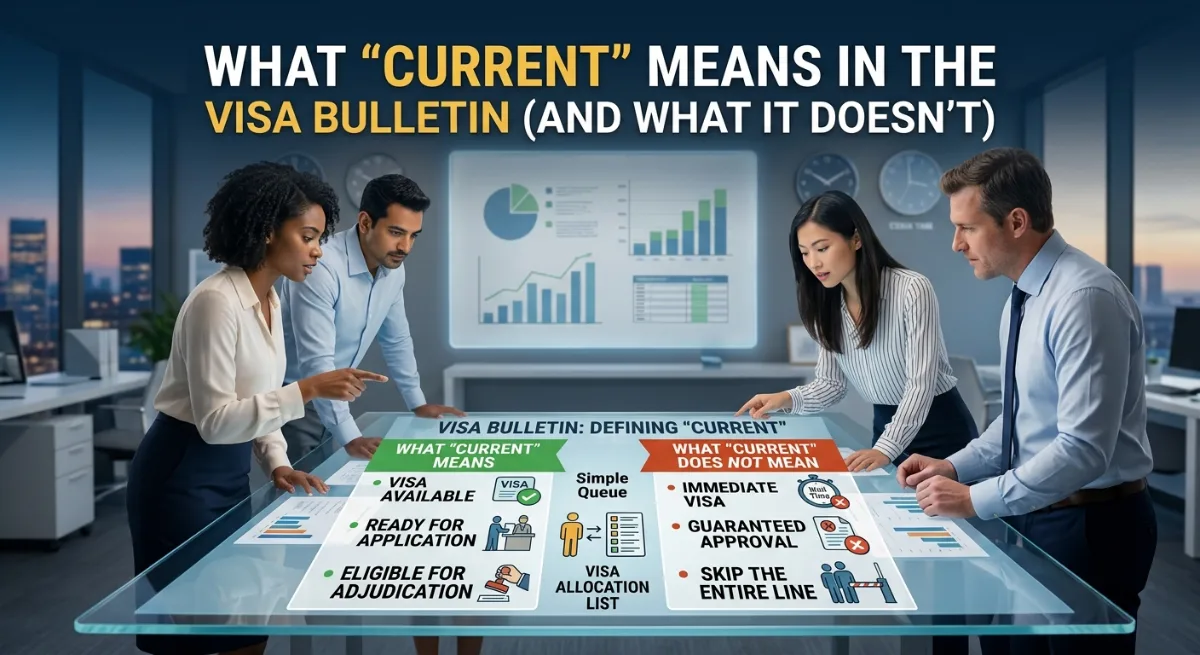
Two symbols show up in the charts instead of dates. "C" means current, and "U" means unavailable. What "current" actually means is the subject of its own article, because it's the most misunderstood word in the bulletin.