Priority Dates Explained From Scratch: What They Are and How to Track Yours
Your priority date decides when a visa number becomes available to you, and almost everything about the wait follows from it. Here is what it is, how it gets set, where to find yours, and a simple routine for tracking it every month.
Published Last updated 4 min read
Not legal advice. This article is general information only. It is not legal advice, and it does not create an attorney–client relationship. Do not rely on it to decide what to do in your own case. Immigration rules change, so confirm current requirements at uscis.gov and talk to a licensed immigration attorney or DOJ-accredited representative.
In this article
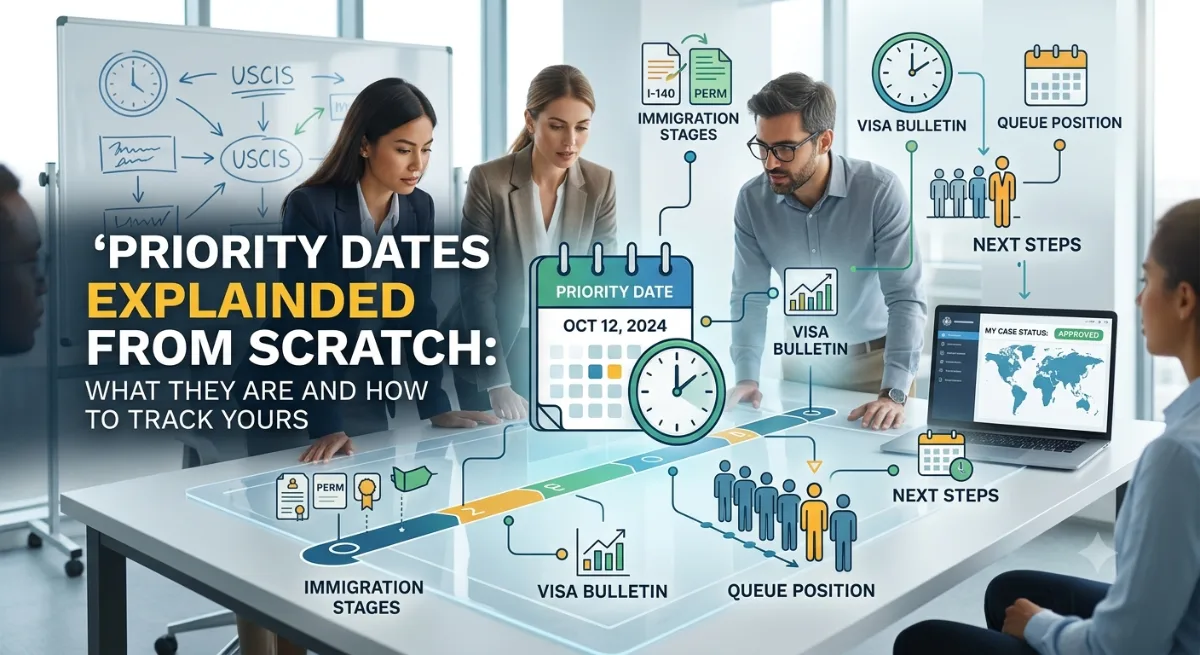
A priority date is your place in line for an immigrant visa. Congress limits how many green cards are available in each family and employment category every year, and limits how many can go to people from any one country. When more people apply than there are visas, the State Department uses priority dates to decide who goes first.
Almost everything about the waiting period follows from that one date. This article covers how it's set, where to find it, why it isn't the same as an approval date, and how to keep track of it. Facts are current as of September 21, 2026.
Who has one, and who doesn't
Only people in numerically limited categories wait in this line. Immediate relatives of U.S. citizens, meaning spouses, unmarried children under 21, and parents of adult citizens, are not subject to the annual limits, so a visa is available to them without a priority-date queue. USCIS explains that category on its immediate relatives page. Everyone else in a family preference or employment category has a priority date.
How the date is set
According to USCIS, the rule depends on the type of case:
- Family-based: the date the Form I-130, Petition for Alien Relative, is properly filed with USCIS.
- Employment-based with a labor certification: the date the Department of Labor accepts the labor certification application for processing.
- Employment-based without a labor certification: the date USCIS accepts the Form I-140 for processing.
- Special immigrants and investors: the date USCIS accepts the relevant petition, Form I-360 or Form I-526, for processing.
Two things follow from those definitions. First, it is the filing date, not the approval date. A petition can take a long time to approve and the priority date stays where it was set on the day of filing. Second, the wording is "properly filed." A filing that USCIS rejects for a defect generally doesn't count as properly filed, so your date can depend on getting the paperwork right the first time. See how to file complete.
Where to find yours
USCIS says you can find your priority date on Form I-797, Notice of Action, for the petition filed on your behalf. Look for the "Priority Date" field on the receipt or approval notice. In an employment case, the I-140 approval notice shows it, and it may reflect the date your employer's labor certification was filed. If you have lost the notice, you can ask USCIS for a duplicate by filing Form I-824, and you should do that before you need the number in a hurry.
A person can also have more than one priority date, for example one from a family petition and another from an employment petition. They are tracked separately, against separate charts.
Your other two coordinates: category and country
A priority date means nothing on its own. To read the bulletin you need three things: your priority date, your category (such as F2A, F4 or EB-3), and your country of chargeability. USCIS notes that per-country limits apply to the visas allotted based on country of chargeability, usually the country of birth. In some situations a person can be charged to a spouse's or parent's country instead, which is a good question for an attorney.
If the petitioner later becomes a U.S. citizen, or a child ages out or marries, the category itself can change. That can change how the priority date is used, so it is worth asking before assuming the old date still works the same way.
A monthly tracking routine
- Write down your three numbers. Priority date, category, country. Keep the I-797 where you can find it.
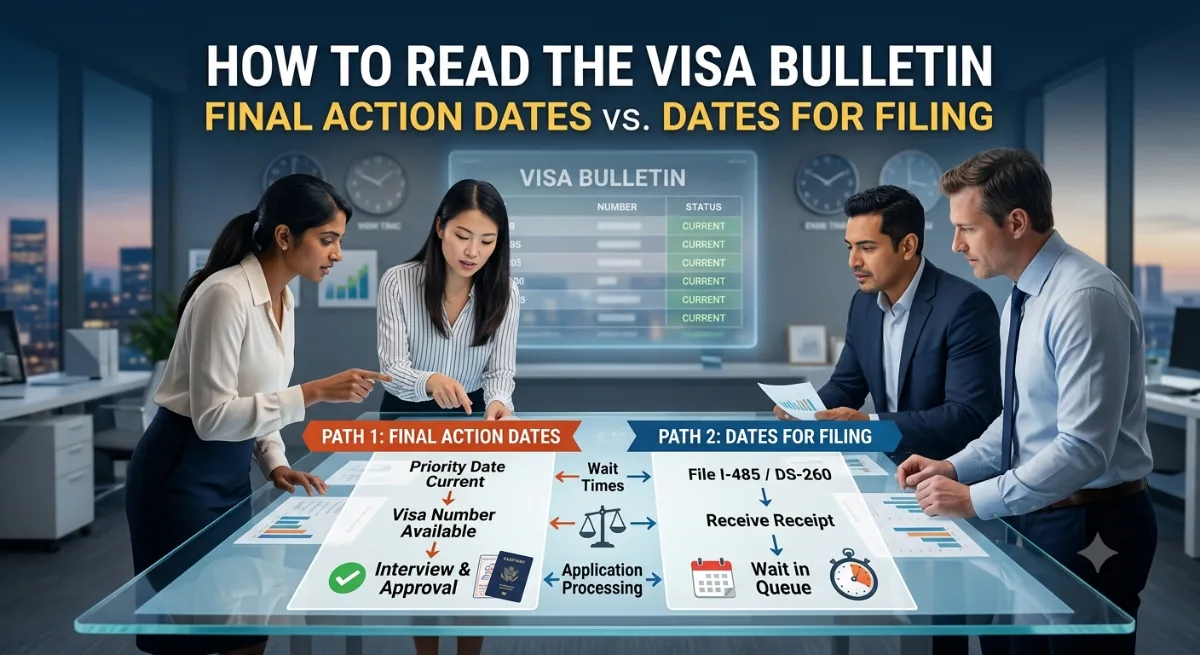
- Open the new Visa Bulletin each month. The State Department publishes it before the month it covers, and each category has two charts. Here is how to read them.
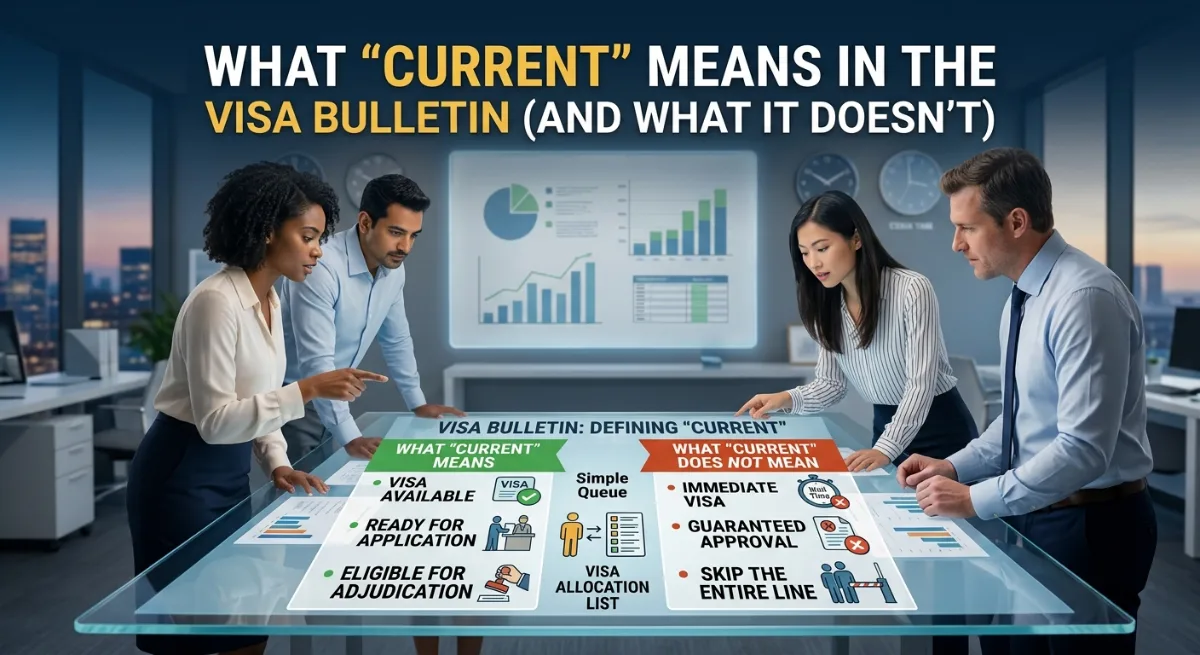
- Compare your date to your row. If your priority date is earlier than the Final Action Date, a visa number is available. If the row shows "C," the category is current. See what that does and doesn't mean.
- Check which chart USCIS wants. If you're filing an adjustment application, USCIS announces monthly on its filing charts page whether to use Dates for Filing or Final Action Dates.
- Keep a log. Note your row's Final Action Date each month. The trend over several months, forward, stalled, or backward, is more informative than any one number.
- Watch for retrogression. USCIS describes it as what happens when more people apply for visas than there are visas available, causing cut-off dates to move backward. A date that was reached last month can be lost.
- If your case is with the National Visa Center, keep your case number and respond to its requests promptly. It contacts you when your date approaches.
What a priority date is not
- It is not a deadline. There is nothing that expires at your priority date; it is a position in a line.
- It is not the date you will get a green card. It is the earliest a visa number can become available to you. Interviews, background checks, admissibility and everything else in your case still have to be completed.
- It is not the same as your case's receipt or approval date, except when the filing and priority date happen to be the same day.
Once your date comes up, the next question is which steps come next, and how long they take. See why an I-485 can take so long for what to expect after a visa number is available.