USCIS Can Now Deny an Incomplete Application Without Asking for More Evidence
A policy update on August 5, 2026 lets USCIS deny a request that lacks required initial evidence without sending a Request for Evidence first. It changes what "file now, fix later" costs you. Here is what changed and how to avoid a denial.
Published Last updated 5 min read
Not legal advice. This article is general information only. It is not legal advice, and it does not create an attorney–client relationship. Do not rely on it to decide what to do in your own case. Immigration rules change, so confirm current requirements at uscis.gov and talk to a licensed immigration attorney or DOJ-accredited representative.
In this article
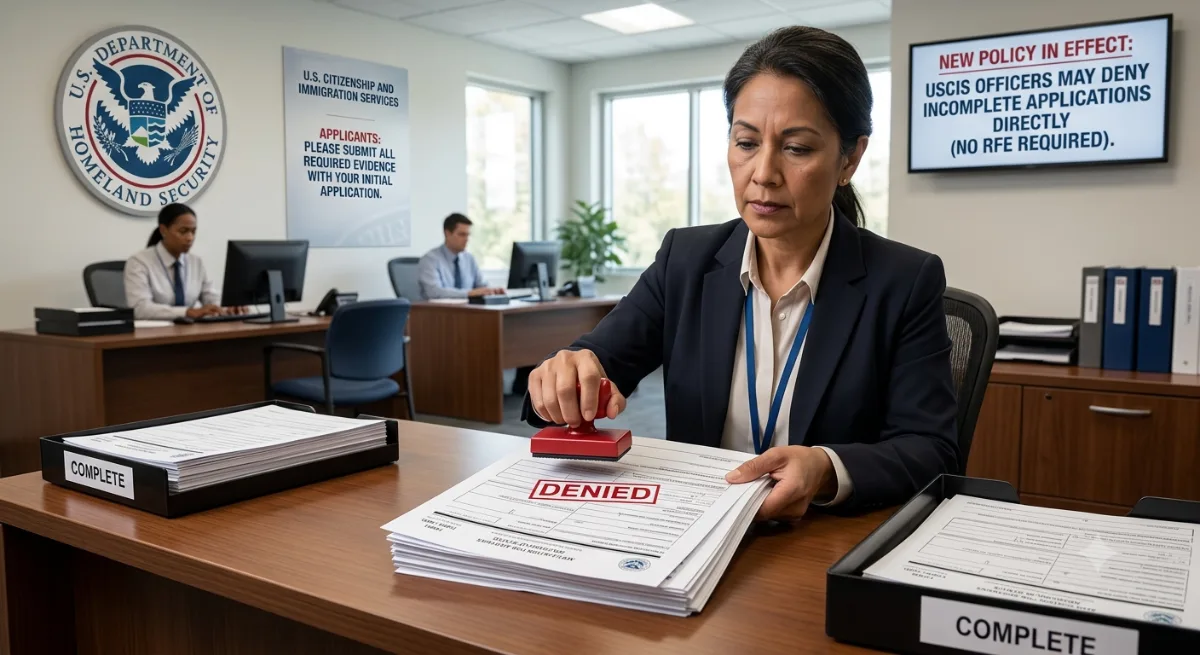
On August 5, 2026, USCIS updated its guidance on evidence, Requests for Evidence (RFEs) and Notices of Intent to Deny (NOIDs). The short version: if your application is missing evidence the form instructions say must be filed with it, an officer may now deny it outright instead of giving you a chance to fix it.
The headline is slightly misleading, though. USCIS is not gaining a new power. The regulations already allowed a denial without an RFE when required initial evidence is missing or the request has no legal basis for approval. What ended is a policy that told officers to issue an RFE or NOID first. This article covers what the new policy says, what it leaves alone, and how to file so it doesn't cost you. Facts are current as of September 21, 2026.
What changed
The update is Policy Alert PA-2026-05. USCIS says the earlier approach encouraged officers to ask for missing evidence, which it argues let people file incomplete "placeholder" applications to collect related benefits, such as work authorization, while their real evidence was still missing. The new guidance restores officers' "full discretion" to deny in those cases without first sending an RFE or NOID.
It took effect immediately and applies to requests that are pending or filed on or after August 5, 2026. That includes cases already sitting in the queue.
"May," not "must"
The policy says that when a requestor doesn't submit all required initial evidence, USCIS "in its discretion may deny the benefit request for lack of initial evidence or for ineligibility or issue an RFE for the missing initial evidence." An RFE is still possible. What you no longer have is an expectation of one.
The regulations also still recognize a NOID as appropriate in a different situation: when you submitted all the required initial evidence but it doesn't establish that you're eligible. So the risk this policy raises is specifically about initial evidence, the items the form instructions require at the time you file.
What counts as initial evidence
USCIS's position is that its "form instructions specify all required initial evidence for every benefit request." Initial evidence is what must be in the package on day one. Additional evidence is what you add to strengthen a case or answer a question later. Only the first kind is where a missing item can now get you denied without a warning.
The same update also clarifies the difference between primary and secondary evidence and how much weight affidavits get when they stand in for missing documents. If a required document truly can't be obtained, read that chapter of the Policy Manual before you file, not after.
RFE deadlines also changed
If you do get an RFE, the timing rules are tighter than they used to be:
- An RFE's response period can't exceed 12 weeks, and a NOID's can't exceed 30 days. Additional time may not be granted.
- Officers are no longer required to give the full 12 weeks. The deadline printed on your notice is the deadline, so don't assume you have 12 weeks.
- Three days are added when a notice is served by mail. The extra 14 days USCIS used to add for notices mailed outside the United States are gone.
- If you send back only some of what was requested, USCIS treats that as a request for a decision. Partial answers can lead straight to a decision on what's in the file.
The last point means that if you respond to an RFE, respond completely, once, before the date on the notice.
How to file so this doesn't happen to you
- Use the current form edition and read its evidence section. For example, USCIS publishes a checklist of required initial evidence for Form I-485. Check off every item against your package.
- Don't file as a placeholder. If you are waiting on a required document, such as a civil record from another country, get it first when you can. If a real deadline forces you to file sooner, talk to a licensed attorney or accredited representative before you do, because an RFE is no longer something you can count on to give you time.
- Put the explanation in the package. If a required document doesn't exist or can't be obtained, include the evidence the instructions allow in its place and a clear written explanation with your filing, so the officer sees it on the first read.
- Keep a full copy of what you send. If a notice arrives, you need to know exactly what USCIS has.
- Watch your mail and act early. Track deadlines from the date on the notice, and send responses with proof of delivery.
A separate problem is a rejection, which is different from a denial. USCIS can return a filing without a decision for defects like a missing signature or wrong fee. You can then correct it and refile. The Policy Manual chapter on submitting requests covers what gets rejected.
If you already have a pending case
Because the policy applies to cases filed before August 5, look at what you submitted against the form's instructions now. If something required is missing, an attorney can advise on whether and how to supplement it. Don't wait to find out through a denial.
What denial looks like, and what it doesn't change
When USCIS denies a request it must send a written denial notice explaining the specific reasons. Your options afterward, such as filing an appeal or motion, or filing again, depend on the form and the reason, and their deadlines are short. Refugee and asylum applications follow different regulations on RFEs, NOIDs and denials, so this update doesn't work the same way for them.
For related reading, see why an I-485 can take so long.