New I-485 and I-864 Editions: The Form Mistakes USCIS Is Rejecting This Fall
USCIS changed several forms in quick succession this fall, and one of the changes was then reversed by a court. Here is which editions of the I-485, I-864, I-765 and I-539 are accepted right now, what the new sponsor credit check means, and the signature mistakes that can now cost you your fee.
Published Last updated 5 min read
Not legal advice. This article is general information only. It is not legal advice, and it does not create an attorney–client relationship. Do not rely on it to decide what to do in your own case. Immigration rules change, so confirm current requirements at uscis.gov and talk to a licensed immigration attorney or DOJ-accredited representative.

In this article
A green card package can be complete, well documented and signed, and still come back unopened because one form is the wrong edition. That has always been true. What's different this fall is how many editions changed at once: USCIS replaced the I-485 with no grace period, replaced the I-864 with a short one, and announced new I-765 and I-539 editions that a court order then put on hold.
Here is where each form stands, and what to check before you mail or upload anything. Facts are current as of September 23, 2026.
Form I-485: only the 09/18/26 edition
USCIS published a new edition of the Application to Register Permanent Residence or Adjust Status on September 18, 2026, to match the new public charge rule. There is no grace period. For anything postmarked or electronically submitted on or after September 18, USCIS will:
- reject the 01/20/25 edition,
- reject the short-lived 09/04/26 edition, published two weeks earlier alongside a separate rule, and
- accept only the 09/18/26 edition.
If you mailed an older edition before September 18, USCIS accepts it. If you mailed an older edition on or after that date, expect it back, and refile with the current one. Because the new edition goes with the new public charge standard, it's worth reading what now counts under public charge before you fill it in.
Form I-864: the old edition works until September 30
The Affidavit of Support has a new 08/24/26 edition, published August 31, 2026. USCIS gave this form a 30-day grace period:
- Through September 30, 2026: USCIS accepts either the 10/17/24 edition or the 08/24/26 edition.
- From October 1, 2026: USCIS will not process a 10/17/24 edition postmarked or submitted on or after that date.
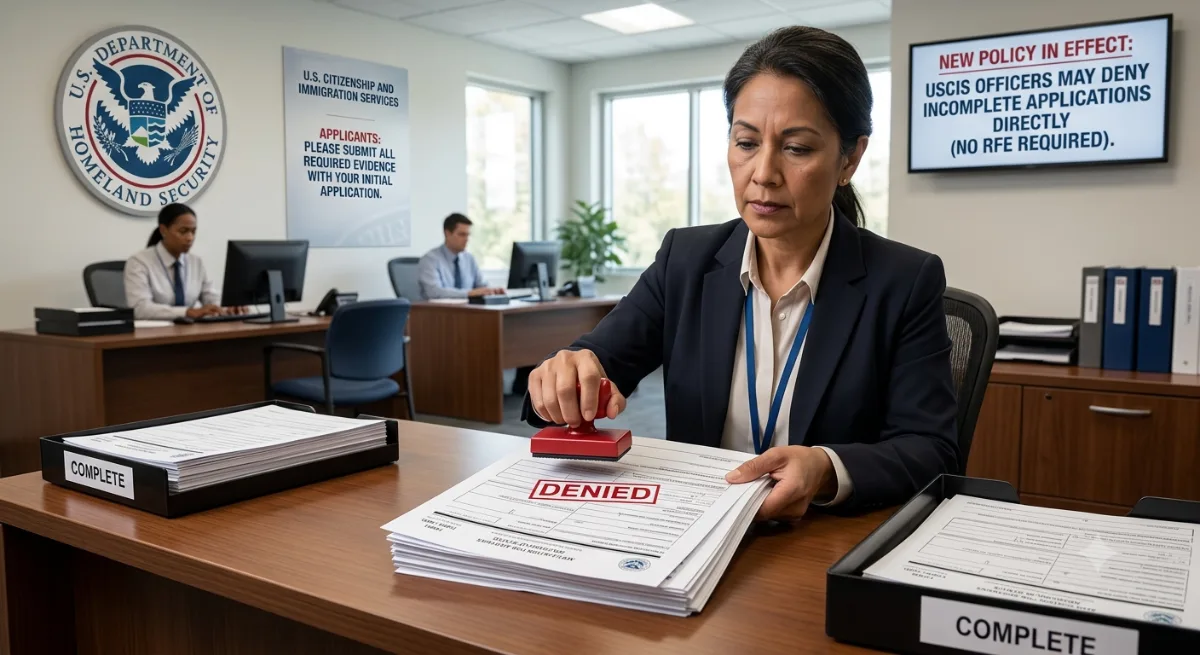
The consequence is different from the I-485. USCIS says it will not reject an I-485 because the I-864 inside it is an old edition. Instead, it treats the old I-864 as missing required initial evidence under 8 CFR 103.2(b)(8). Since August 5, 2026, officers may deny a case for missing initial evidence without first sending a request for evidence, so a stale I-864 is a real risk rather than a paperwork nuisance. See how the deny-without-RFE policy works.
The new credit check, and why a credit freeze matters
The 08/24/26 edition includes a privacy release that authorizes USCIS to request information about the sponsor from one or more consumer reporting agencies. In plain terms, signing it lets USCIS pull the sponsor's credit report. USCIS hasn't published any minimum credit score, and the form doesn't create one.
The practical issue is a credit freeze. USCIS warns that if a sponsor has a credit or security freeze on their file, it may not be able to get the information it needs to assess whether the I-864 is sufficient, and it tells sponsors to respond quickly to any request to lift the freeze. Many people froze their credit years ago after a data breach and have forgotten. If you are sponsoring someone, check with all three bureaus before you file, and know how you would temporarily lift a freeze if USCIS asks. A joint sponsor files a separate I-864, so the same advice applies to them.
Forms I-765 and I-539: do not use the newest edition
This one catches people who do the right thing and download the latest form. USCIS had announced new 09/15/26 editions of Form I-765 (work permits) and Form I-539 (extending or changing nonimmigrant status), with no grace period, tied to a rule that would have ended "duration of status" for students and exchange visitors. On September 14, 2026, a federal court blocked that rule. Following the order, USCIS says it:
- continues to accept the 08/21/25 edition of Form I-765,
- continues to accept the 08/28/24 edition of Form I-539, and
- is not accepting the 09/15/26 editions of either form.
If you saved a copy of the 09/15/26 edition in early September, delete it. Students affected by the same court order can read what the ruling means for F-1 status and CPT.
Signatures: a mistake that can now cost the fee
A separate rule that took effect July 10, 2026 changes what happens when USCIS finds a signature problem after it has already accepted your filing. Previously, a bad signature caught at that stage generally led to a rejection, and the fee came back. Now an officer may reject or deny the request, and a denial lets USCIS keep the fee. You would then have to file again and pay again.
USCIS describes a valid signature as a handwritten mark made by the person filing. A scanned, faxed or photocopied version of a form signed in ink is fine. These are not:
- a typed name,
- a signature stamp, unless the form instructions allow one,
- a signature added by signature software, or an image of a signature pasted onto the form,
- a form signed by someone else, such as an attorney, preparer or interpreter, on the applicant's behalf.
Online filings are signed electronically as part of the USCIS account process, which is one reason signature problems are mostly a paper-filing issue.
A five-minute check before you file
- Look at the bottom of every page. The edition date is printed there. Every page of a form must come from the same edition, with the page numbers visible. USCIS may reject a form with missing pages or mixed editions.
- Compare it with the form's page on uscis.gov on the day you file, not the day you downloaded it. Each form page has an "Edition Date" section and, when something is changing, an alert at the top.
- Mind the postmark. Deadlines turn on the postmark or electronic submission date. If you are close to October 1 with an old I-864, reprint it on the new edition rather than race the mail.
- Sign in ink, personally. Each person signs their own form. Don't let a preparer sign for you.
- Keep a full copy. If something is rejected or questioned, you need to know exactly what you sent.
Form changes are also happening alongside a push toward online filing. USCIS can now require some forms to be filed online, with 60 days' notice. See what mandatory e-filing means for you.
Official sources
- Form I-485 page, including the edition alerts (USCIS) and the Aug. 19, 2026 alert announcing the new edition
- Form I-864 page, including the grace period and credit freeze notice (USCIS)
- Form I-765 page and Form I-539 page, with the notice on the Sept. 14, 2026 court order (USCIS)
- Signatures on Immigration Benefit Requests, interim final rule (Federal Register, May 11, 2026; effective July 10, 2026)